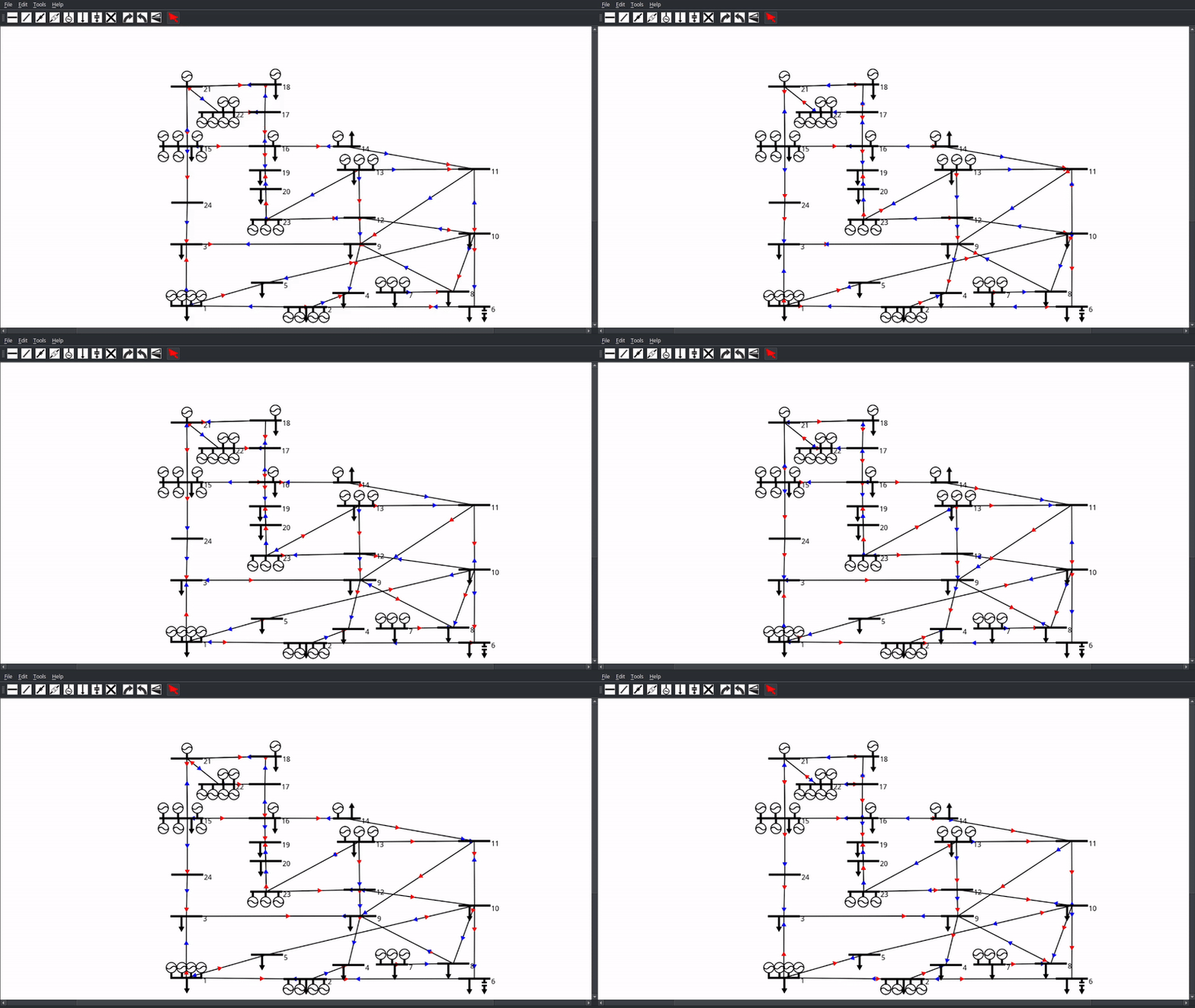
Understanding qualitatively power systems networks can be a challenging task. Power networks can be very large but analyzing even a small network can sometimes be an ambitious undertaking. A number of different power network simulators, both commercial and free, have been developed to deal with this problem. Commercial packages provide, sometimes very impressive, visualization tools but can be quite expensive, between $10k and $20k per year. At the same time, such packages are proprietary and lack flexibility to experiment with different algorithms and scenarios. On the other side, free packages do not provide visualization tools but are very flexible to develop new algorithms and experiment with the old ones. Lack of user friendly Graphical User Interface (GUI) and ability to visualize the results can be a major limitation regardless of how good the algorithms and simulation results are. Matpower Viewer, or MPV for short, is a GUI front end that uses public domain Matpower power systems simulator as the back end. MPV can be used to both view and edit Matpower networks. MPV is designed to be easily integrated with different type back ends. Since Matpower has been developed and tested for over 30 years and runs well under both Matlab and Octave, MPV provides a cheap GUI interface to industrial strength solution.
MPV can be used as a standalone application to edit or view Matpower networks or in parallel with Matpower to also display simulation results. The communication between MPV and Matpower is done through Matlab binary *.mat files. A common scenario would be to enter the Matpower network using MPV, export it to *.mat file, run Matpower algorithms using this file, save the results to the same or different *.mat file and sync it with MPV. All this can be done without exiting MPV or Matlab. An MPV file can be exported to Matlab *.mat or *.m file and *.png file inclusion in a presentation or publication. This scenario allows to analyze and visualize the results using various classical and modern power systems algorithms including ones based on Machine Learning (ML) and Artificial Intelligence (AI) considering that Matpower can be expended with Matlab and Octave scripts or user’s hard coded solutions. Since power networks can be very large and almost always the user is interested in only a small part of it, MPV can display only a part of the network or even multiple disconnected parts to observe remote interaction among them.